

Customers are talking about your product everywhere. Sales calls, support tickets, app reviews, surveys, social posts, Slack channels. The signals are constant. The hard part is hearing them.
Most of that feedback never reaches the people who can act on it. It sits buried in transcripts, scattered across tools, or summarized into a score that hides what went wrong.
Voice of the customer (VoC) tools exist to fix that gap. The category covers everything from $30/month survey tools to $300,000/year enterprise platforms. Some focus on product feedback. Others on contact center analytics. A few specialize in win-loss research. The right pick depends less on features and more on fit with your team, your data, and your decisions.
This post compares 13 VoC tools across features, pricing, and best fit.
Tools we cover
Here’s a quick overview of the tools we’ll cover:
- Canny — AI-native customer intelligence for product teams, capturing feedback from sales and support conversations and tying it to revenue
- Qualtrics XM — enterprise experience management with deep survey logic and predictive analytics
- Medallia — enterprise CX platform with omnichannel signal capture and AI-driven action
- Sprinklr Insights — AI-powered consumer intelligence across social, reviews, and digital channels
- InMoment XI — enterprise feedback platform combining surveys, text analytics, and case management
- Hotjar — behavioral analytics with heatmaps, session recordings, and on-site surveys
- Sprig — in-product surveys and replays with AI-powered analysis for product teams
- SurveyMonkey — broad-purpose survey platform with multi-channel distribution
- AskNicely — NPS-focused CX platform built for multi-location service businesses
- Thematic — AI text analytics that extracts themes from open-text feedback
- Chattermill — AI feedback intelligence platform unifying multi-source customer data
- Enterpret — adaptive AI taxonomy for product teams analyzing high-volume feedback
- Clozd — win-loss analysis platform combining software with managed buyer interviews
How we evaluated these tools
Voice of the customer tools cover a wide range of jobs. Some capture feedback. Some analyze it. Some help you act on it. Most do a few of those things, with different strengths.
We focused on five criteria that matter most when picking a tool. Each one shapes how the platform works for your team.
Feedback capture across channels
Capture is the foundation of any VoC program. The best tools pull feedback from wherever it lives. That includes surveys, support tickets, sales calls, app reviews, social posts, and community forums.
Tools that rely on surveys alone miss a lot. A frustrated customer rarely fills out an NPS survey. They’re more likely to rant in a support ticket or a Slack message. Multi-channel capture closes those gaps.
We looked at three things: source count, capture automation, and whether each tool pulls unstructured text alongside structured scores.
AI feedback analysis
AI is everywhere in this space. The interesting question is what it does. Some tools use AI to tag and theme open-text responses. Others use it to predict churn or surface anomalies. A few do both.
We looked at theme detection, sentiment analysis, and insight quality. Specifically, how well each tool turns raw feedback into something a leadership team can use.
AI quality keeps improving across the category. Tools that don’t keep up fall behind.
Closing the loop
Capture and analysis matter, but they’re only useful if someone acts on them. Closing the loop means routing feedback, updating customers, and tying outcomes back to the original request.
Some tools have built-in case management. Others sync to Jira or Linear. A few automate customer follow-up directly.
A tool that can’t close the loop is just a dashboard.
Which teams it supports
VoC tools live in different parts of the org. Some serve enterprise CX leaders running multi-channel programs. Others focus on product managers prioritizing the roadmap. A few support frontline service teams.
The wrong tool for your team will feel either over-engineered or too thin. Matching the tool to your primary use case matters more than counting features.
Pricing transparency
Most tools in this space don’t publish pricing. That’s a friction point during evaluation. It’s also a signal about who they sell to.
Tools with public pricing serve self-serve buyers. Tools with custom-only pricing usually require sales calls, longer sales cycles, and bigger budgets. Both models are valid. The question is which one fits how your team buys software.
We used third-party data from Vendr, SpendHound, and ITQlick to estimate real costs where vendors don’t disclose them.
Canny
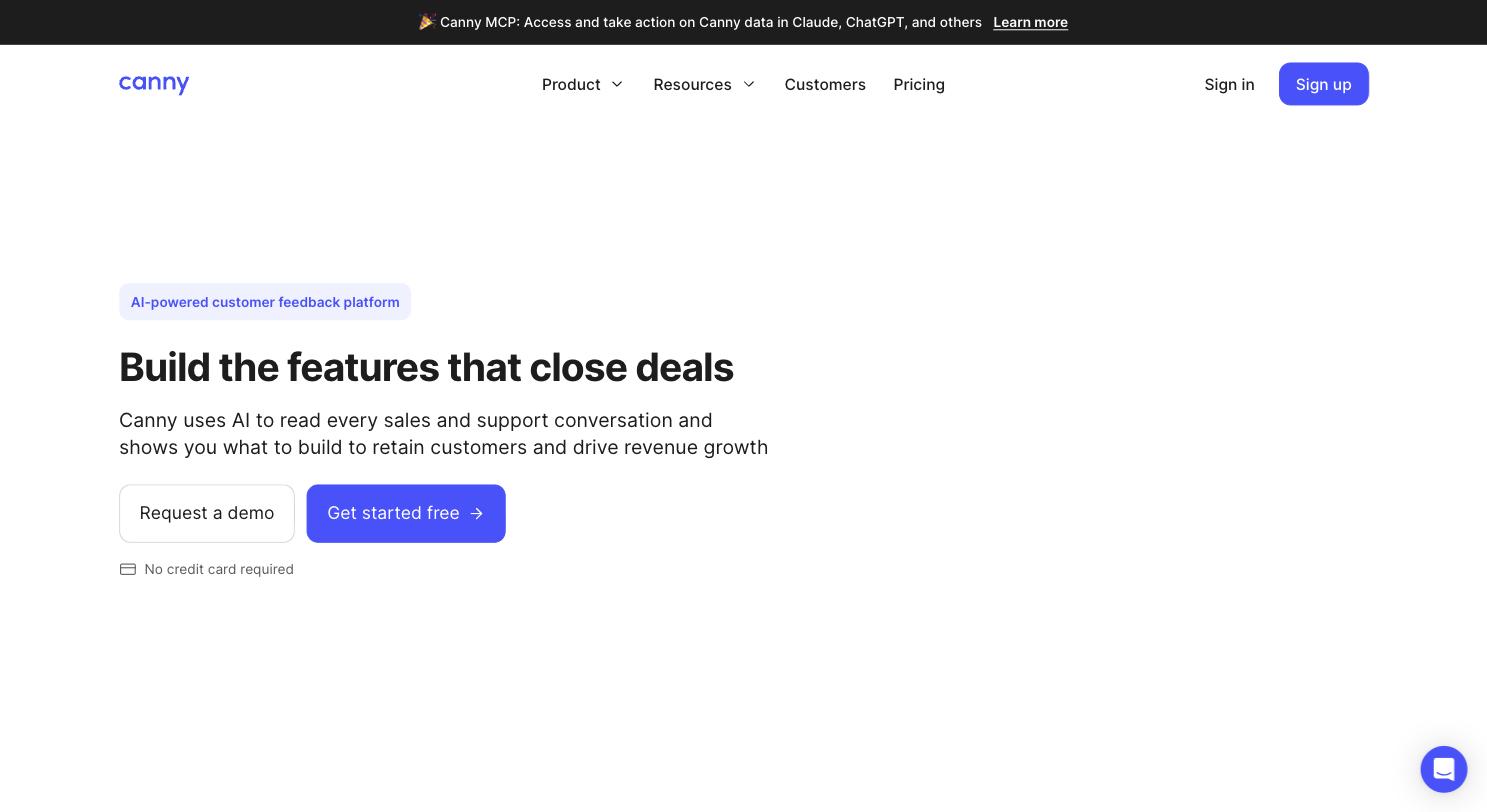
Canny is a customer feedback platform for software companies. Its AI, Autopilot, captures feedback from sales calls, support tickets, and chat, then ties every request to revenue. Thousands of B2B SaaS companies use Canny across product, support, sales, and exec teams. Its core differentiator is closing the feedback loop end to end, from capture to roadmap to changelog.
Features
- Autopilot AI feedback capture from Gong, Intercom, Zendesk, Slack, and more
- Revenue-based prioritization tying requests to deal size and ARR
- Automatic deduplication that merges similar requests
- Customer segmentation by plan, revenue, or any custom attribute
- Public feedback boards for customers to submit and vote on ideas
- Public roadmap and changelog to communicate what’s coming and what shipped
- Integrations with Jira, Linear, Intercom, and more, plus Salesforce as a Business plan add-on
- MCP server that lets Claude, ChatGPT, and Cursor query feedback and create or update requests directly
Pricing
Canny offers three plans. Free ($0) covers 25 tracked users. Pro starts at $79/month billed annually, or $99/month billed monthly, at 100 tracked users. Business (custom pricing) is built for teams with 5,000+ tracked users. Pricing scales by tracked users, which means anyone who submits, votes, or comments on feedback. Source: canny.io/pricing.
When it’s the right choice
- You want feedback captured automatically from conversations you’re already having, without sending surveys
- You want one tool that captures, prioritizes, and closes the loop with customers
- Your team wants AI feedback analysis to tie feature requests to revenue impact
- You want a public feedback board customers can vote on directly
- Multiple teams (product, support, sales, exec) need shared visibility into requests
- You want AI feedback capture without setting up a separate analytics tool
When it might not be the right fit
- You need native NPS or CSAT surveys (Canny ingests survey data via Zapier or Send to Autopilot, but doesn’t run surveys itself)
- You need real-time alerting on incidents or sentiment spikes
- Your primary use case is analyzing thousands of support calls for theme detection at enterprise scale
- You need session replays or heatmaps
Qualtrics XM
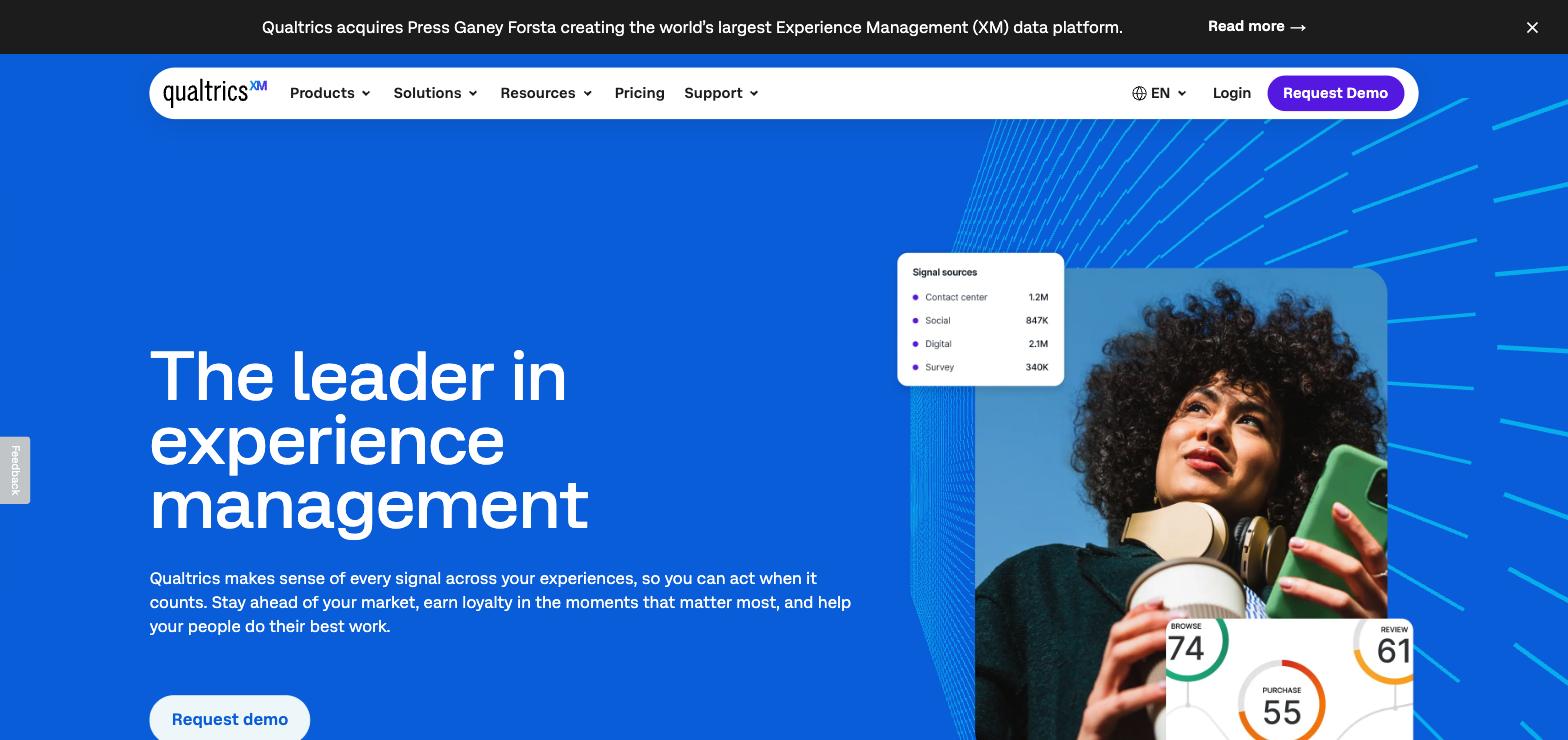
Qualtrics is the category-defining experience management platform. It covers customer, employee, brand, and product experience across surveys, calls, chats, and digital touchpoints. Qualtrics targets enterprise programs with dedicated CX teams and significant budgets.
Features
- Sophisticated survey design with advanced logic, branching, and conditional flows
- Predictive intelligence that forecasts churn and identifies at-risk segments
- Text and sentiment analysis across open-text responses, calls, and digital interactions
- Omnichannel feedback capture across email, SMS, web, mobile, IoT, social, and reviews
- Role-specific dashboards for executives, frontline managers, and analysts
- Case management workflows with closed-loop tracking
- Qualtrics AI for pattern detection across structured and unstructured feedback
- Integrations with Salesforce, Zendesk, Jira, and major CRMs
Pricing
Qualtrics doesn’t publish full pricing. The self-serve Strategic Research plan starts at $420/month. According to Vendr’s analysis of 262 contracts, the median annual spend is $28,591, with a range of $6,525 to $126,600. SpendHound puts the SMB average near $39,665/year and enterprise near $658,000/year. Implementation services typically add five figures in Year 1.
When it’s the right choice
- You’re running a formal enterprise CX program with multiple business units
- You need advanced survey methodology like MaxDiff, conjoint analysis, or longitudinal tracking
- You have a dedicated team to design dashboards and configure workflows
- You’re consolidating multiple point solutions into one platform
- You have budget for six-figure annual contracts and professional services
When it might not be the right fit
- You’re a small or mid-market team without dedicated CX resources
- You need fast time to value (Qualtrics implementations typically take weeks to months)
- Pricing transparency matters for your evaluation process
- You only need basic surveys without advanced research requirements
Medallia
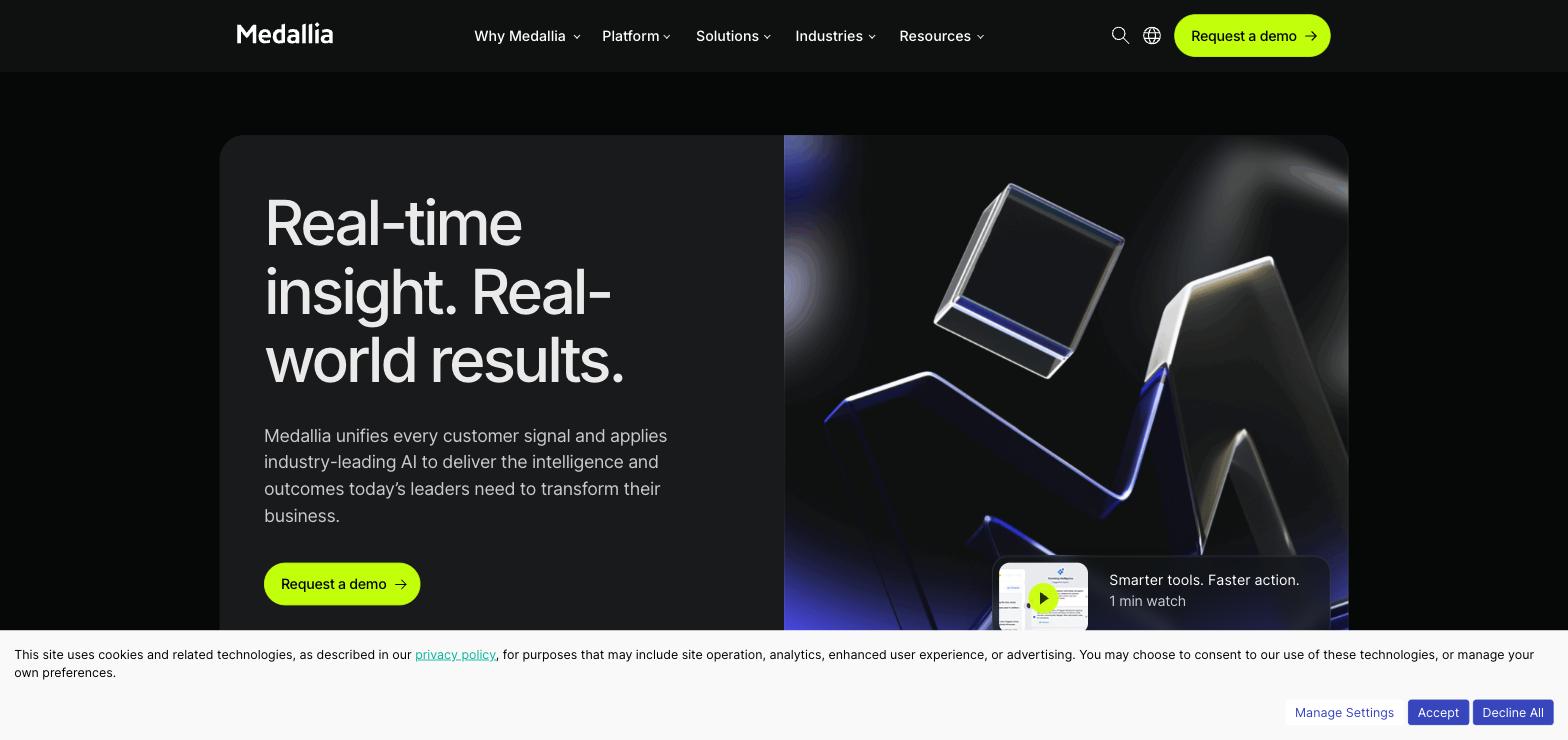
Medallia is an enterprise customer experience platform that captures feedback signals across surveys, social, digital, voice, and connected devices. Its Athena AI surfaces patterns and predicts behavior in real time. Medallia is built for large global organizations with complex customer journeys.
Features
- Omnichannel signal capture across email, social, web, mobile, calls, and IoT
- Athena AI for pattern detection and predictive analytics
- Real-time alerts when sentiment shifts or KPIs decline
- Closed-loop case management with frontline workflows
- Speech analytics for contact center conversations
- Role-specific dashboards from the C-suite to frontline staff
- Customer segmentation across structured and unstructured data
- Integrations with Salesforce, Adobe Analytics, and major enterprise systems
Pricing
Medallia uses an Experience Data Records pricing model that bundles data, analytics, workflows, and security into a single contract. ITQlick estimates licenses start at $20,000/year, with onboarding fees of $5,000 to $50,000+. Most enterprise contracts run into six figures. Forrester’s TEI study cites $1.5 million in implementation costs and multi-million annual subscription costs for the composite organization studied.
When it’s the right choice
- You’re a global enterprise with millions of customer interactions to manage
- You need speech analytics for high-volume contact center work
- Frontline activation matters and you have the workforce to support it
- You want unlimited users without per-seat licensing
- Your CX program needs deep integration with operational systems
When it might not be the right fit
- You’re a mid-market company without enterprise CX resources
- You want fast self-serve onboarding
- Implementation timelines matter (typical deployments take about five months, and standard rollouts can run six to 12 months)
- Your team is small and a complex platform would slow you down
Sprinklr Insights
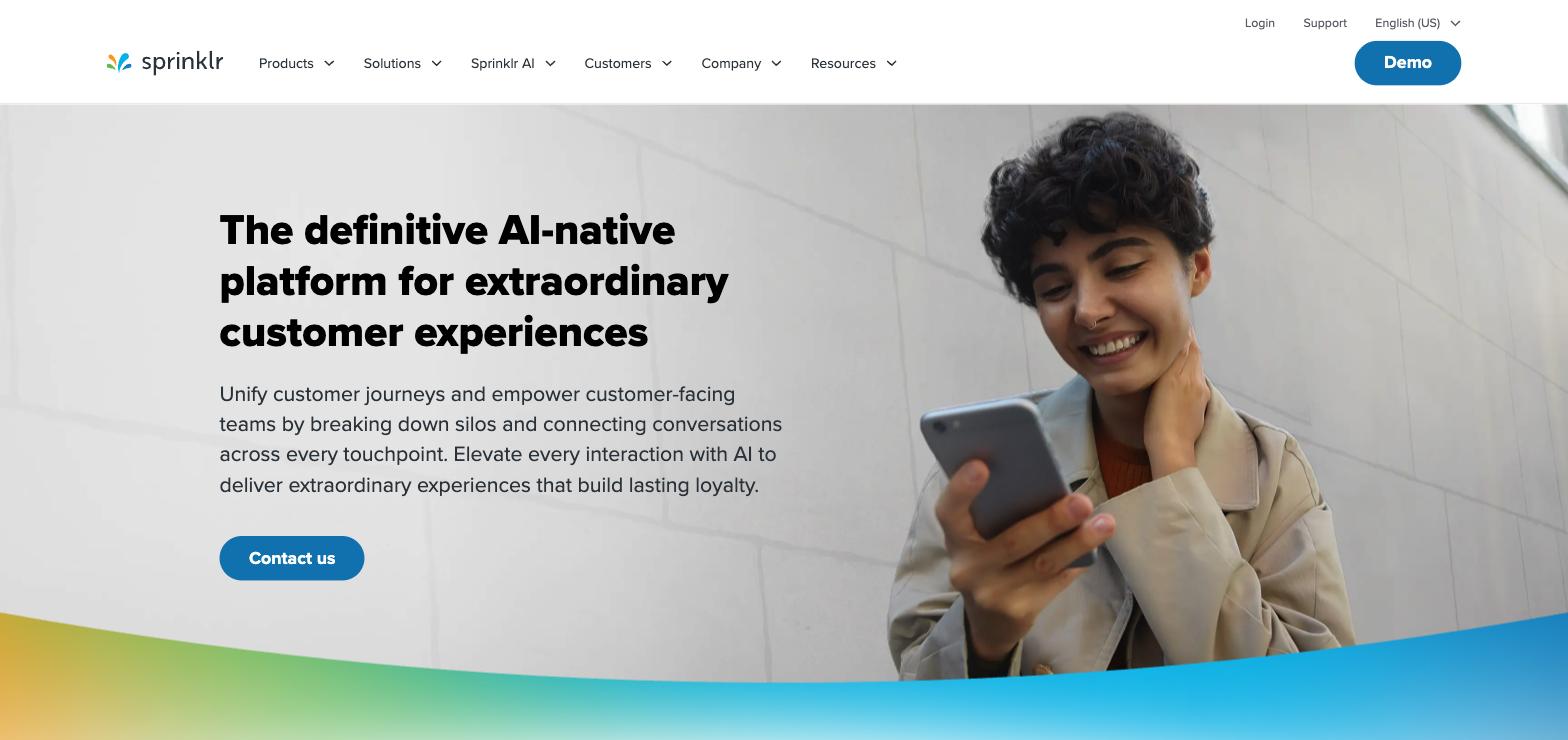
Sprinklr Insights is an AI-powered consumer intelligence platform that analyzes feedback across social, reviews, news, and digital channels. It’s part of the broader Sprinklr unified CXM (customer experience management) suite. Insights focuses on real-time brand and competitive intelligence at enterprise scale.
Features
- Real-time listening across 30+ digital and social channels
- AI sentiment analysis with intent and theme detection
- Competitive benchmarking with 10+ reporting dashboards
- Visual and content analytics for brand monitoring
- Premium media monitoring with crisis detection
- Product Insights tracking customer reviews across many websites
- Customizable dashboards with widget-level configuration
- Integration with Sprinklr Service and Social modules
Pricing
Sprinklr Insights is enterprise quote-based with no published pricing. Sprinklr Service self-serve starts at $249/seat/month and Social Advanced at $299/seat/month, but Insights is enterprise-only. Per eesel AI’s analysis, median Sprinklr enterprise contracts run $93,510/year with a range of $15,000 to $387,000+. Vendr’s median sits closer to $129,000/year. Insights bills by mention volume, with overage fees if you exceed quota.
When it’s the right choice
- You’re a large brand managing reputation across many digital channels
- Social listening is a core part of your VoC program
- You need competitive benchmarking against named rivals
- You have a dedicated analytics team to manage the platform
- You operate across 30+ countries and need broad media coverage
When it might not be the right fit
- You’re a mid-market team without analyst resources
- You don’t need social or media monitoring as core functionality
- Mention volume is unpredictable and overage fees would be a problem
- Your primary feedback channels are private (support tickets, surveys, sales calls)
InMoment XI Platform
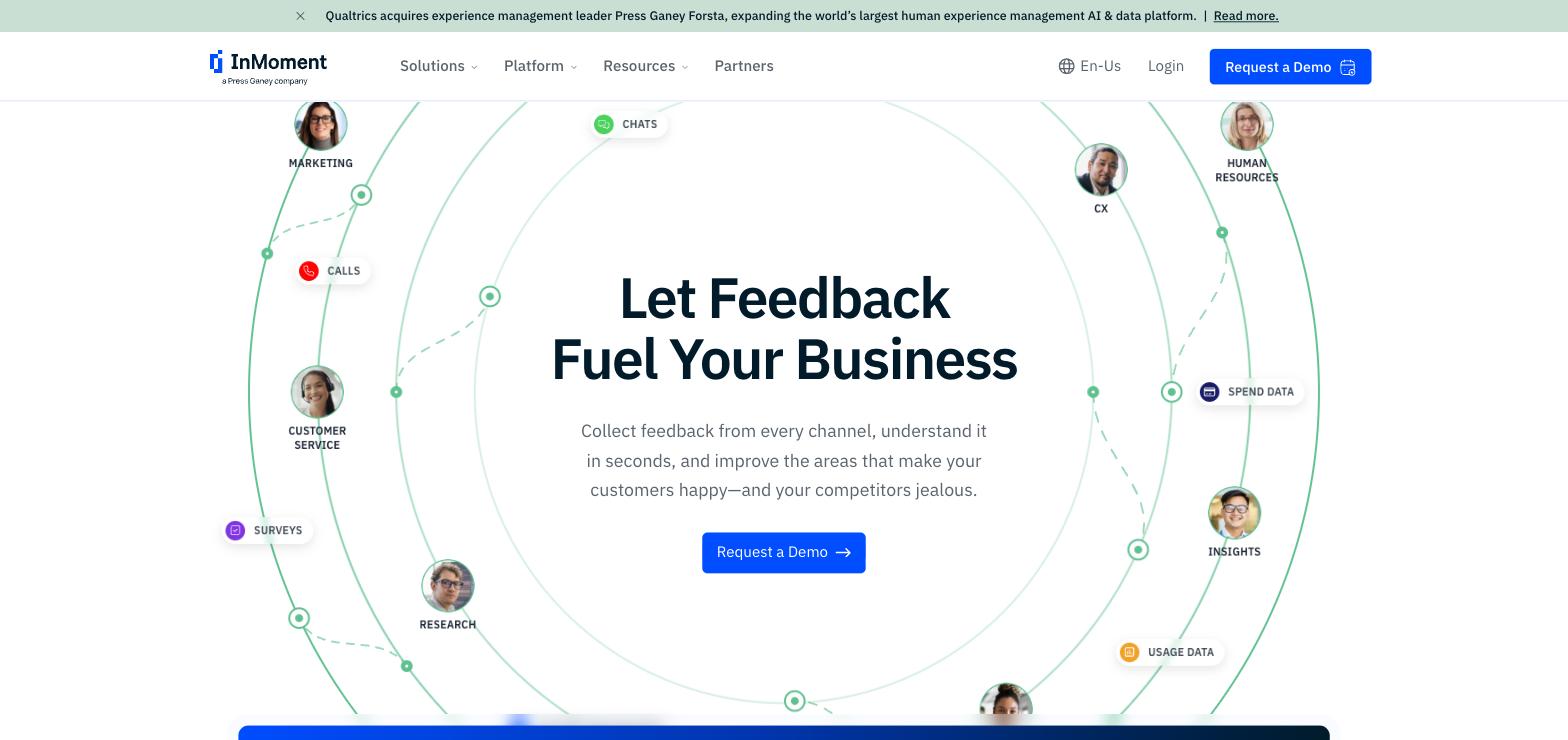
InMoment is an experience improvement platform that captures and analyzes customer feedback across surveys, social, digital, calls, and support tickets. The XI platform combines AI text analytics with rapid resolution workflows. Press Ganey Forsta acquired InMoment in May 2025, and the platform continues to operate under the InMoment brand.
Features
- Multi-channel feedback capture across surveys, calls, emails, chat, and reviews
- AI text analytics with automated theme and sentiment detection
- Rapid Resolution Engine for closed-loop case management
- Real-time alerts on customer issues
- Mixed-mode surveys combining structured and unstructured questions
- Journey mapping across digital and physical touchpoints
- Role-specific dashboards for executives and frontline staff
- Integrations with Salesforce, Zendesk, and major enterprise tools
Pricing
InMoment doesn’t publish pricing. ITQlick estimates licenses start at $20,000/year with onboarding fees of $5,000 to $50,000. Vendr notes that pricing scales with feedback volume and company size.
When it’s the right choice
- You want strong account management and consultative onboarding
- You need text analytics combined with case management in one tool
- Your CX team has time for a structured rollout
- You operate in regulated industries (healthcare, finance, automotive)
- You need digital listening alongside survey-based feedback
When it might not be the right fit
- You want highly flexible dashboard customization out of the box
- You need a fast self-serve setup
- Reporting flexibility is critical (some users cite limitations)
- You want a lighter, more product-focused tool
Hotjar
Hotjar is a behavioral analytics platform with heatmaps, session recordings, surveys, and user interview tools. Product and UX teams use it to understand how visitors interact with websites and apps. Contentsquare acquired Hotjar in 2021, completed the legal merger in July 2025, and is now migrating pricing to a unified Contentsquare platform.
Features
- Heatmaps showing where users click, scroll, and hover
- Session recordings with frustration signal detection
- On-site surveys and feedback widgets with AI sentiment analysis
- AI survey generator for fast question creation
- User interview scheduling with participant pool access (Engage)
- Funnel analysis tracking conversion drop-offs
- Multi-language support across 40+ languages
- Integrations with Slack, HubSpot, Zapier, and major analytics tools
Pricing
Hotjar is mid-migration to Contentsquare’s unified plans. Legacy Hotjar Observe (heatmaps and recordings) ranges from Free to $213/month. Legacy Ask (surveys) ranges from Free to $159/month. Legacy Engage (interviews) starts free and reaches €550/month for the Business tier. The new unified Contentsquare Growth plan starts at $49/month, with Pro and Enterprise tiers requiring a custom quote. Contentsquare is migrating existing customers gradually through 2026.
When it’s the right choice
- You need behavioral data alongside customer feedback
- Your product or UX team wants to see what users actually do, not just what they say
- You run a high-traffic site or app where heatmaps add value
- You want a low-cost entry point with a generous free tier
- You need on-site surveys triggered by user behavior
When it might not be the right fit
- Your VoC focus is enterprise survey programs
- You need text analytics across many feedback sources
- Daily session caps would limit your data capture
- Pricing predictability matters during the Contentsquare migration
Sprig
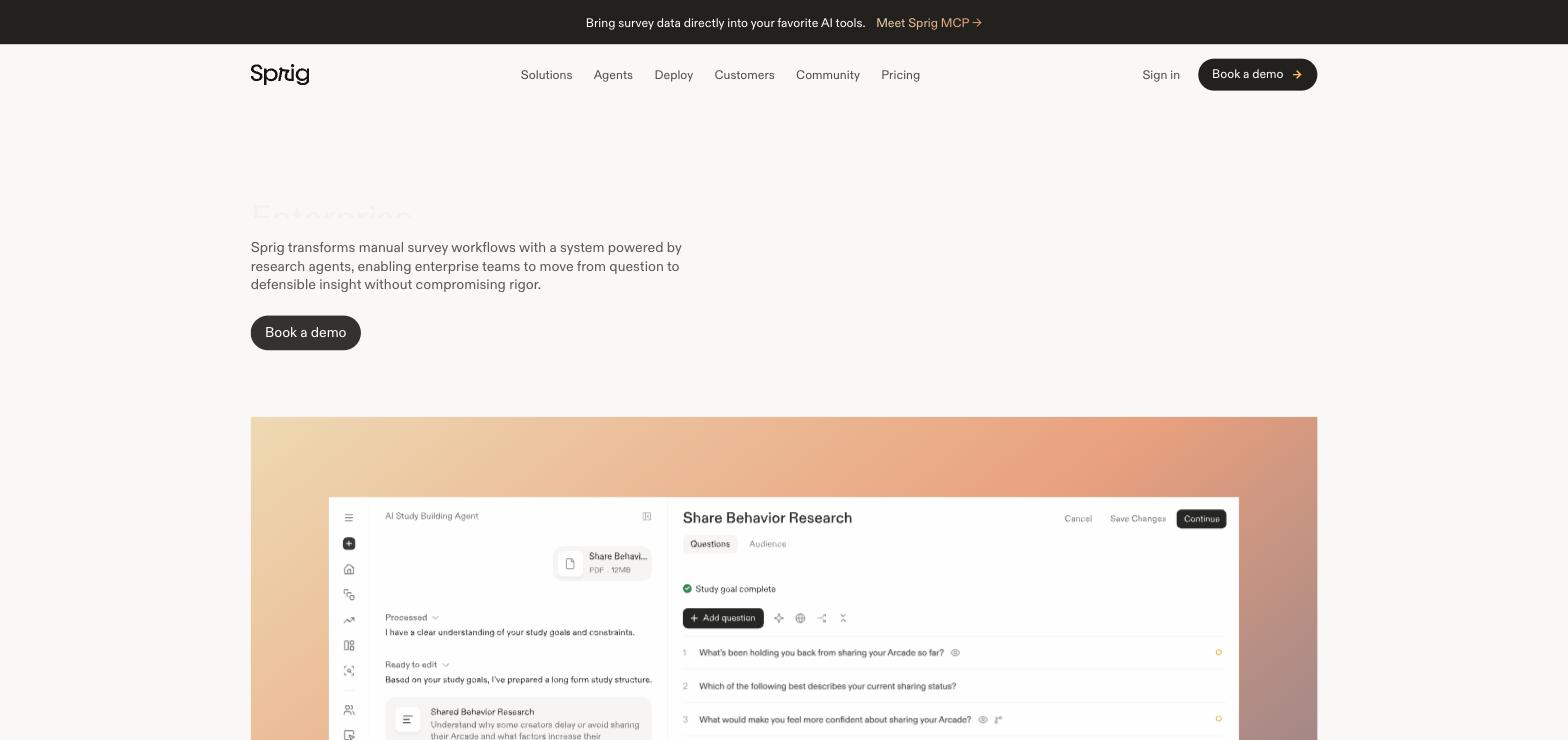
Sprig is a product experience platform that runs in-product surveys, session replays, and heatmaps with AI-powered analysis. It targets product, design, and research teams who want to capture user insights at specific moments in the journey. Sprig was originally UserLeap.
Features
- In-product surveys triggered by user behavior or events
- Session replays with AI-driven theme grouping
- Heatmaps with automatic analysis
- Long-form surveys distributable via email, SMS, and link
- AI analysis that synthesizes responses into themes in real time
- Always-on feedback widgets in web and mobile apps
- API access for custom workflows (Enterprise)
- Integrations with Slack, Jira, Salesforce, Snowflake, and Enterpret
Pricing
Sprig offers a Free plan (one survey, 5,000 monthly unique users or MUUs), Starter at $175/month annually ($199 monthly, two surveys, 25,000 MUUs), and Enterprise (custom). Pricing scales by study units and monthly unique users. Source: sprig.com/pricing.
When it’s the right choice
- Your product team wants contextual feedback at specific moments
- You need session replays and heatmaps alongside surveys
- AI analysis is a core requirement for synthesizing open-text responses
- You’re already running an experimentation or research program
- You want a product-focused alternative to enterprise CX platforms
When it might not be the right fit
- You don’t have an app or web product to embed surveys in
- You need to run more than two surveys at once on the smaller plans
- Your primary use case is analyzing support or sales conversations
- You want a public feedback board or roadmap
SurveyMonkey
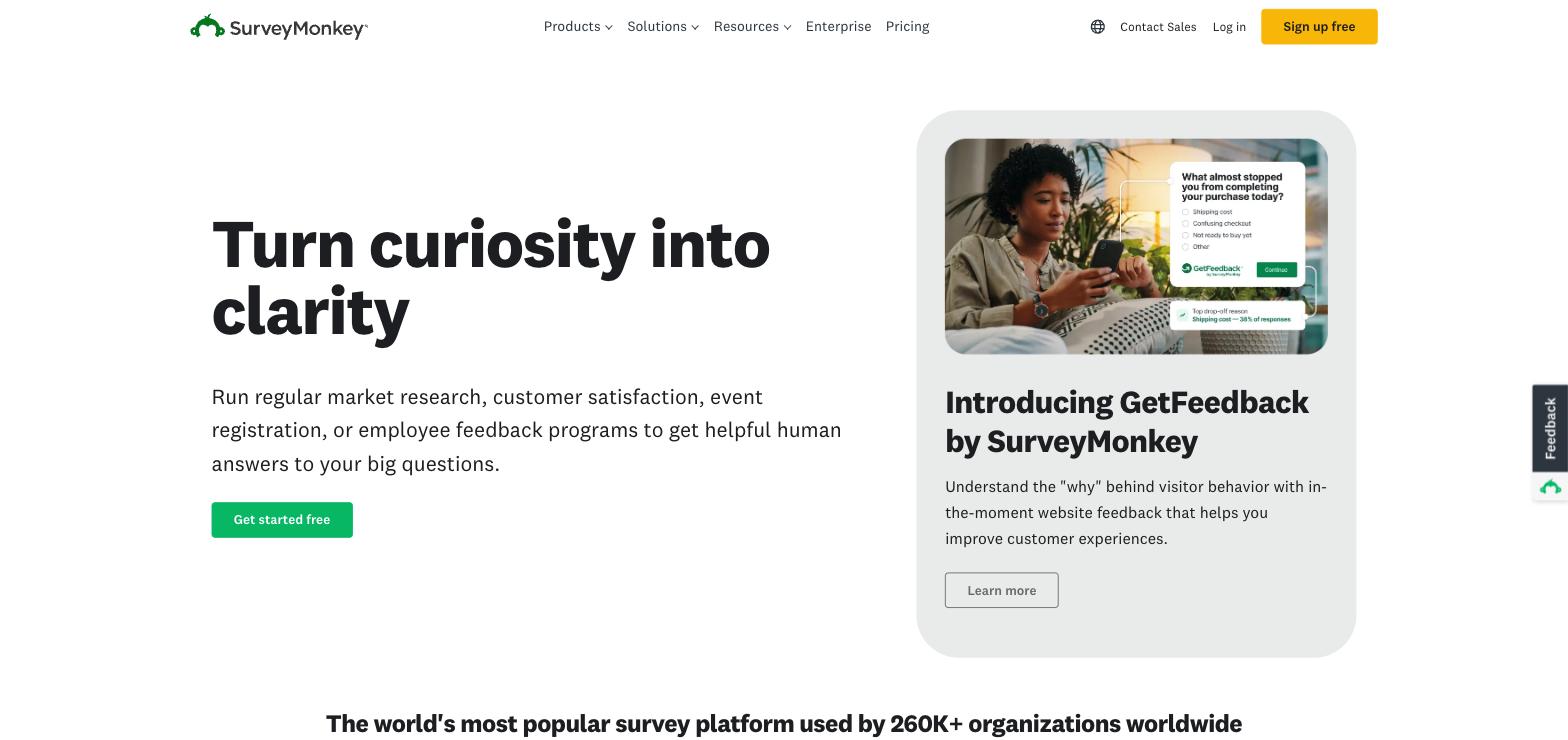
SurveyMonkey is the most recognized survey platform in the world. Individuals, teams, and enterprises use it across every industry. It covers everything from quick polls to complex CX research programs.
Features
- AI-powered survey building with the Build with AI prompt tool
- Multi-channel distribution via email, SMS, WhatsApp, web, and QR codes
- AI sentiment analysis on open-text responses
- NPS, CSAT, and CES tracking with benchmark data
- Multilingual surveys across 40+ languages
- Advanced logic including branching, piping, and randomization
- HIPAA compliance and enterprise security on Enterprise plans
- 200+ integrations with Salesforce, Slack, HubSpot, and major business tools
Pricing
SurveyMonkey offers Free (10 questions, 25 responses), Advantage Annual ($39/month annual), Premier Annual ($139/month annual), Team Advantage ($30/user/month, 3-user min), Team Premier ($92/user/month, 3-user min), and Enterprise (custom). Third-party data puts real Enterprise contracts near $40,000/year on average. Watch for per-response overage charges above plan limits. Source: surveymonkey.com/pricing.
When it’s the right choice
- You need a broad-purpose survey tool for many use cases
- Your team wants self-serve onboarding without sales calls
- You’re running surveys across departments (HR, marketing, CX, research)
- Budget predictability and transparent pricing matter
- You want a tool most stakeholders already know how to use
When it might not be the right fit
- You need deep AI text analytics across multi-source feedback
- Your VoC program goes beyond surveys into calls, social, and tickets
- You’ve outgrown survey-only feedback collection
- You need behavioral data alongside survey responses
AskNicely
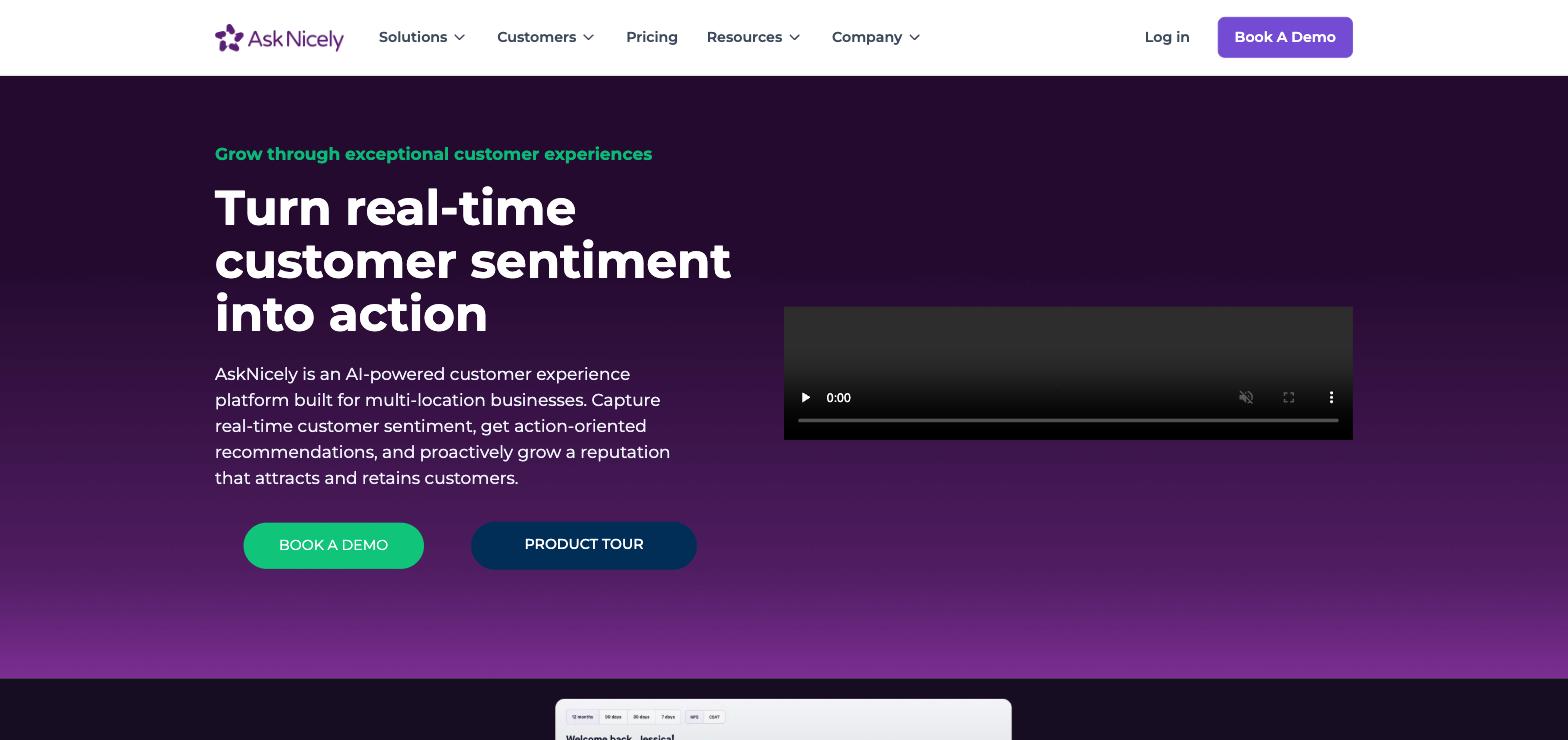
AskNicely is a customer experience platform built for multi-location service businesses. It centers on NPS and CSAT surveys with built-in workflows for frontline coaching and team activation. Franchises, healthcare networks, fitness brands, and home service companies use it heavily.
Features
- NPS, CSAT, and CES surveys with chat-style interface
- Real-time feedback automation across email, SMS, and web
- Frontline coaching mobile app for service teams
- Real-time TV dashboards and leaderboards for in-store displays
- Automated review and referral generation from happy customers
- Workflow engine for closing the loop with customers
- Text analytics with theme detection on survey responses
- 20+ integrations including Salesforce, Slack, and Snowflake
Pricing
AskNicely publishes three plans: Learn at $449/month, Grow at $849/month, and Transform at $999/month. All plans bill annually and start at 500 responses with volume-based scaling. SSO is a $1,500/year add-on. Plans above $9,600/year include a dedicated CSM. Source: asknicely.com.
When it’s the right choice
- You operate a multi-location service business
- Frontline team activation is core to your CX program
- You want gamified leaderboards and real-time displays for staff
- NPS and CSAT are your primary feedback metrics
- You want strong automation around closing the loop
When it might not be the right fit
- You’re a B2B SaaS company without frontline service teams
- You need text analytics across non-survey feedback sources
- Your VoC program covers product feedback, not service quality
- Pricing flexibility matters for smaller deployments
Thematic
Thematic is an AI-powered text analytics platform that turns open-text feedback into themes, sentiment scores, and impact measurements. It serves CX, insights, and research teams who need to quantify qualitative data. Thematic ingests feedback from your existing tools rather than running surveys itself.
Features
- AI thematic analysis that surfaces themes without manual taxonomy setup
- Theme editor with human-in-the-loop refinement
- Sentiment analysis at the phrase level
- Impact scoring tying themes to NPS, CSAT, or business outcomes
- Multilingual analysis across 40+ languages
- PII redaction and data residency controls
- Dashboards for cross-functional teams (product, CX, operations)
- Integrations with Qualtrics, Zendesk, Salesforce, and major data warehouses
Pricing
Thematic’s Foundation Plan starts at $25,000/year. Vendr data shows real contracts average around $35,000/year with a range of $15,000 to $46,000. Enterprise pricing is custom. Source: G2 listing and getthematic.com.
When it’s the right choice
- You already collect feedback and need better analysis
- Your team needs research-grade theme detection at scale
- You want to quantify open-text feedback for executive reporting
- Multilingual analysis is a hard requirement
- You have an insights or research function that owns the platform
When it might not be the right fit
- You don’t have a high volume of qualitative feedback yet
- You need feedback collection alongside analysis
- Your budget is below the $25,000/year entry point
- You want a tool that suggests next-best actions, not just analysis
Chattermill
Chattermill is an AI-native voice of customer platform. It unifies feedback from multiple channels and analyzes it with deep learning models. The platform serves CX-focused teams at high-volume consumer brands. Customers include Uber, HelloFresh, Amazon, and Tesco.
Features
- Lyra AI for granular theme detection
- Sentiment analysis with phrase-level precision
- Impact analysis correlating themes with NPS, CSAT, and revenue
- Real-time alerts on emerging issues
- Unified dashboards across surveys, reviews, support tickets, and social
- MCP server for querying insights from AI agents
- Multilingual analysis across 100+ languages
- 50+ integrations with Zendesk, Trustpilot, Qualtrics, and Intercom
Pricing
Chattermill doesn’t publish list pricing. Vendr data shows contracts average $64,000/year. Pricing scales by data sources and feedback volume, with no per-user fee. Source: chattermill.com/plans.
When it’s the right choice
- You’re a high-volume consumer brand with feedback across many channels
- You need AI accuracy and granularity at enterprise scale
- Your CX program needs theme detection tied to revenue impact
- You want unlimited users without per-seat licensing
- You have a dedicated CX or insights team to own the platform
When it might not be the right fit
- You’re a smaller team without enterprise budget
- You need a feedback collection tool, not analytics
- Dashboard simplicity matters for stakeholder adoption
- You want a public feedback board or roadmap
Enterpret
Enterpret is a customer feedback intelligence platform built for product and CX teams at fast-growing companies. It uses adaptive AI taxonomies that evolve as new feedback arrives. Customers include Notion, Canva, Strava, Loom, and Linear.
Features
- Adaptive Taxonomy that builds and refines categories automatically
- Wisdom AI agent for natural-language queries on feedback data
- Real-time anomaly alerts on emerging issues
- Customer cohort comparison across segments and revenue tiers
- Sales intelligence module for analyzing deal feedback
- Sentiment analysis with multi-source unification
- API and Slack delivery for surfacing insights in workflows
- 50+ integrations with Zendesk, Salesforce, Intercom, Slack, and Gong
Pricing
Enterpret doesn’t publish pricing. Pricing is usage-based, billed by the volume of feedback records processed, with no per-user fee. Industry estimates put contracts in the $30,000 to $100,000+/year range.
When it’s the right choice
- You’re a product-led company with high-volume feedback across many sources
- Your team wants adaptive AI that evolves rather than fixed taxonomies
- Cross-functional teams need self-serve access to feedback insights
- You want to tie feedback to revenue and customer cohorts
- You have an insights function ready to own the platform
When it might not be the right fit
- You’re a small team without enterprise budget
- You need feedback collection alongside analysis
- You want a public feedback board for customers to vote on requests
- Setup complexity is a concern
Clozd
Clozd is a win-loss analysis platform that combines software with managed buyer interview services. It helps revenue and product marketing teams understand why deals close, or why they don’t. Enterprise software companies running formal win-loss programs use Clozd widely.
Features
- Live buyer interviews conducted by Clozd’s neutral third-party team
- Flex AI Interviews for asynchronous feedback at scale
- Real-time transcription and AI-powered theme tagging
- Salesforce integration with automated outreach and scheduling
- Slack integration delivering interview insights in real time
- Ask Clozd, an AI search tool for analyzing interview data
- Executive dashboards with deal-driver analysis
- Custom summary reports with quote-level evidence
Pricing
Clozd uses custom pricing combining a flat platform fee with per-interview costs. Vendr data shows contracts average $50,100/year, with most falling between roughly $26,000 and $130,000. Managed-service programs commonly run $90,000 to $120,000 annually. Enterprise programs (300+ interviews) run $200,000 to $400,000+/year. There’s no per-user fee.
When it’s the right choice
- You’re an enterprise software company with high-value B2B deals
- You want neutral third-party buyers giving honest feedback
- Win-rate improvement is a measurable revenue lever
- Product marketing or competitive intelligence owns the program
- You want managed services rather than a DIY interview program
When it might not be the right fit
- You’re early-stage or have low deal volume
- Your average deal size doesn’t justify the program cost
- You want a self-serve tool with no managed service component
- Your team can run win-loss interviews internally with existing resources
Comparison table
| Tool | Primary teams | Primary capture method | Closing the loop | Starting price | G2 rating |
|---|---|---|---|---|---|
| Canny | Product, support, sales, exec | Multi-source | Yes | Free, then $79/mo | 4.6 |
| Qualtrics XM | Enterprise CX, research | Multi-source | Yes | $420/mo self-serve; ~$29K/yr median | 4.3 |
| Medallia | Enterprise CX | Multi-source | Yes | Custom (~$20K/yr min) | 4.5 |
| Sprinklr Insights | Enterprise CX, brand | Social listening | Limited | Custom (~$93K/yr median) | 4.3 |
| InMoment | Enterprise CX | Multi-source | Yes | Custom (~$20K/yr min) | 4.7 |
| Hotjar | Product, UX | In-product | Limited | Free, then $49/mo | 4.3 |
| Sprig | Product, research | In-product | Limited | Free, then $175/mo | 4.5 |
| SurveyMonkey | Cross-functional | Surveys | Limited | Free, then $30/user/mo | 4.4 |
| AskNicely | Service, frontline | Surveys | Yes | $449/mo | 4.7 |
| Thematic | CX, insights, research | Pulls from existing tools | No | $25K/yr | 4.8 |
| Chattermill | Enterprise CX | Pulls from existing tools | Limited | Custom (~$64K/yr avg) | 4.5 |
| Enterpret | Product, CX | Pulls from existing tools | Limited | Custom (usage-based) | 4.6 |
| Clozd | Sales, PMM, exec | Buyer interviews | Limited | Custom (~$50K/yr median) | 4.8 |
Multi-source = own collection, integrations, plus captures from existing tools. Pulls from existing tools = ingests feedback collected elsewhere.
How to choose the right VoC tool
The right VoC tool depends less on the feature list and more on how your team works. A 30-person SaaS startup and a global retail brand both need to listen to customers. The systems that serve them look very different.
The most useful question isn’t “which tool is best?” It’s “what decision are we trying to make?” A win-loss program, a frontline coaching system, and a product roadmap all need different things. Pick the tool that fits the answer.
Most VoC programs fail at the same step. Teams gather feedback, run reports, and then move on. The tool only matters if it leads to action. Pick something you’ll open every week.
Canny works best for product-led SaaS teams. It captures feedback from your customer conversations, ties every request to revenue, and closes the loop when features ship. See how product teams use Canny as their voice of customer tool.