Did you know that generative AI (artificial intelligence) first appeared in the 1960s (in chatbots)? Turns out AI isn’t that new after all! But the time to take advantage of it is definitely now.
AI’s projected to continue growing. It’s valued at nearly 100 billion USD and is expected to grow 20x by 2030 – up to almost two trillion USD (Statista).
AI-skilled product managers earn up to 28% more than their peers. They also save at least four hours every week on core tasks like research, specs, and meeting notes.
The right AI tools follow your workflow: discovery first, then definition, then design, communication, and analytics.
General-purpose LLMs like ChatGPT and Claude are your most flexible tools. Purpose-built PM tools like ChatPRD handle the specifics.
Feedback is an area where AI pays off fast. Tools like Canny Autopilot automatically surface, deduplicate, and group feedback. Your roadmap practically writes itself.
No single tool does everything. The PMs getting the most out of AI build a small, intentional stack — not a collection of tools.
Why AI tools matter for product managers
The question used to be whether PMs should use AI tools. That question is settled.
The real question now is how fast you build the habit. Roles requiring AI skills command a 28% salary premium over comparable positions. That figure comes from a Lightcast analysis of over a billion job postings. A McKinsey study of 40 product managers found AI tools improved productivity by 40%. Every single participant reported improvement.
That translates to real time back in your week. In a survey of 1,750 product professionals by Lenny Rachitsky, 63% of PMs said AI saves them four or more hours every week. That’s half a working day freed up for the work only you can do.
What got us here? A few things converged. We now have more data than ever, and everyone needs a way to manage it. We finally have the computational power to run AI at scale. Open-source development accelerated progress faster than anyone predicted. Generative AI made all of it accessible to anyone with a question to ask.
Generative AI is the category driving most of the change right now. It produces human-like content: text, images, code, and more. For PMs, that means research, documentation, analysis, and communication. These are the tasks that used to eat your afternoons.
The question on everyone’s mind is still: will AI replace me as a PM? Here’s what Rachel Wynn, a product expert and coach, thinks.
“Artificial intelligence tools will help great product managers work better. They are a catalyst for product managers to uplevel their skills and focus on work that AI can’t do. This is good news for everyone. If product managers are worried about AI taking over their jobs, they should learn to use AI while further developing the skills.”
— Rachel Wynn, Founder & Coach at Wynn Product Consulting
AI isn’t here to take your job. It’s here to help you do it better.
So let’s explore the best AI tools for product managers, organized by the stages of your workflow.
Note #1: We’re breaking these tools down by workflow stage. Some blur the lines between stages.
Note #2: This is not a comprehensive list of every AI tool. These are the top tools we either use or find genuinely useful for product managers. Want to add a tool? Shoot us a message! Check out our list of the best product management tools too.
Stage 1: Research and discovery
Tools that help PMs find signal, gather feedback, and understand users before building anything.
Canny
Canny is now AI-powered through Autopilot. Its suite of tools automates the most time-consuming parts of feedback management.
Here’s the problem Autopilot solves: feedback arrives from everywhere. Support tickets, sales calls, app store reviews, Slack messages. Most of it never makes it into a structured system. Autopilot changes that.
Feedback Discovery connects to your existing tools: Intercom, Zendesk, Help Scout, Gong, and more. It automatically scans conversations for feedback you would have missed. In a real-world test with a customer’s Zendesk tickets, Autopilot identified 93% of feature requests accurately. It captured 30% more feedback than the team’s manual process.
Deduplication handles the noise. When the same request comes in from different users or channels, Autopilot merges them automatically and counts the votes. Your feedback board stays clean. The signal stays clear.
Auto-grouping organizes new ideas into the right categories based on your group hierarchy. This is where Autopilot connects directly to roadmapping. When feedback is already organized and deduplicated, prioritization becomes much faster. You can see your most-requested features at a glance.
Canny also connects to AI tools directly via an MCP server (Model Context Protocol, an open standard that lets AI tools connect to external data sources). Your feedback data flows into whatever AI stack you’re building. You can merge and manage ideas without leaving your workflow.
“Canny’s Autopilot ensures feature requests never fall through the cracks. We’ve seen an 80% increase in requests logged since introducing Autopilot.”
— Owen Doherty, COO at OrcaScan
Perplexity
Perplexity is an AI-powered research tool. It’s become the standard for competitive intelligence among product managers. Unlike a general-purpose chatbot, Perplexity searches the web in real time and cites its sources. You can verify everything it returns.
Product managers use Perplexity to:
Research competitors and market trends quickly
Get sourced summaries of industry news
Answer specific research questions with citations
Validate assumptions before writing specs
The result is faster, more credible research. There’s no hallucination risk, unlike with standard LLMs.
NotebookLM
NotebookLM is Google’s AI research tool. It works exclusively on documents you upload. That constraint is its superpower: it only draws on your sources, so it can’t hallucinate.
Upload your user research transcripts, competitive analysis docs, or customer interview notes. NotebookLM summarizes them and answers questions about them. It also generates a podcast-style audio summary of your findings, which is useful for sharing research with a team that won’t read a 30-page report.
For PMs who run their own research, NotebookLM is the fastest way to synthesize large volumes of qualitative data.
Granola
Granola is an AI notepad for meetings. It runs in the background during calls, captures everything said, and produces a structured summary when the call ends. The summary is formatted to whatever template you need.
What sets Granola apart is that it works with your own notes. You jot down the things that matter to you during the call. Granola fills in the rest. The output combines your notes with its transcript, giving you a summary that reflects what you actually found important.
Granola makes note-taking on customer calls, stakeholder syncs, or sprint planning sessions easy.
tl;dv
tl;dv is a meeting recorder that transcribes and summarizes your calls. It’s useful for calls with customers, prospects, and your team.
Within seconds after the call, you get a full recording, transcript, and AI summary. It also automatically logs action items in your favorite productivity tool.
“I’ve enjoyed using call recording tools for customer calls. Tools like tl;dv help synthesize information from customer calls. I like using these AI summaries alongside my notes. The latter focus on non-verbal communication.”
— Rachel Wynn, Founder & Coach at Wynn Product Consulting
Instead of worrying about taking notes, PMs can focus on being present. tl;dv integrates with all popular video meeting tools and lets you create clips from recordings.
“tl;dv empowers product managers to customize their AI summary output. For example, you can tag a conversation as a UX research interview or a sprint planning session. Our AI can automatically recognize and tag bug mentions or UX feedback and send it to your favorite tool (like Canny).”
Tools that help PMs turn research into specs, roadmaps, and prioritized backlogs.
This stage has two types of tools. General-purpose AI refers to large language models (LLMs), flexible systems trained on vast amounts of text. You can adapt them to almost any PM task with the right prompt.
Purpose-built PM tools are pre-configured for specific product management workflows. They require less prompting and produce more consistent results for the tasks they’re designed for. Most effective PM stacks use both.
General-purpose AI
ChatGPT
ChatGPT, a chatbot by OpenAI, is at the top of the list. Many SaaS tools use ChatGPT to power their AI components, and for good reason.
ChatGPT’s latest model, GPT-4o, handles text, images, and files in a single conversation. It goes well beyond text generation.
Product managers have successfully used ChatGPT to:
Prioritize ideas
Manage data
Create launch plans
Write and refine PRDs
Brainstorm feature names and positioning
We’ve covered seven different use cases from top product managers. Check it out for ideas and prompts!
Claude
Claude, by Anthropic, has become a go-to LLM for product managers who work with long, complex documents. Its standout feature is a large context window. You can paste in an entire PRD, a research transcript, or a backlog of feedback and ask Claude to reason across all of it at once.
Product managers use Claude to:
Write and critique product requirements documents
Synthesize large volumes of research into structured summaries
Draft strategy documents and roadmap narratives
Review specs for gaps and contradictions
Claude Projects lets you maintain persistent context across conversations. Upload your strategy docs, PRDs, and research once. Then, every subsequent conversation has a full background. It’s particularly useful for PMs managing complex product areas with a lot of institutional context.
Google Gemini
Gemini is Google’s AI assistant. It’s a conversational generative AI deeply integrated with Google’s products and services. Gemini 2.0 Flash, the latest iteration, is notably fast and handles text, images, and real-time information.
Product managers can use Gemini to:
Quickly learn about new developments in the industry
Gather competitive intel
Analyze images
Write support documentation
Summarize articles
Create project plans
Brainstorm and prioritize ideas
Analyze feedback
Notion AI
Notion is all about smarter document organization. Notion AI is built directly into your workspace. AI is available wherever your docs already live, no context-switching required.
ChatPRD is an AI copilot built specifically for product managers. A general-purpose LLM requires you to craft the right prompt. ChatPRD comes pre-loaded with PM frameworks. You describe what you’re building and it generates structured output in formats your team already uses. Think PRDs, user stories, acceptance criteria, and OKRs.
Product managers use ChatPRD to:
Write first drafts of product requirements documents
Generate user stories from a feature description
Create interview guides for user research
Build OKR frameworks for new initiatives
ChatPRD has become one of the most searched PM-specific AI tools, with over 100,000 PMs using it. For teams that write a lot of specs, it removes the blank-page problem entirely.
ClickUp AI
ClickUp is a tool many teams use for project and product management. We use it daily at Canny! ClickUp AI brings AI directly into your planning workflow.
Linear is a project management tool popular with software teams. Its AI layer has made it a standout for PMs managing complex backlogs. Linear AI automatically triages new issues, suggests the right team or project to assign them to, and surfaces duplicate tickets before they accumulate.
Product managers use Linear AI to:
Triage incoming issues without manual sorting
Identify and merge duplicate feature requests
Auto-generate issue summaries for sprint planning
Surface related issues when writing new tickets
The time saved in sprint planning alone makes Linear AI worth evaluating for any team already using Linear.
Stage 3: Design and prototyping
Tools that help PMs visualize ideas, build fast, and test before engineering picks it up.
Figma
Figma is known and loved by designers around the globe. Our design team at Canny uses it too!
Figma AI is now deeply integrated across the platform. It can generate UI components, suggest design improvements, and produce production-ready code directly from your designs.
PMs can now visualize their ideas faster and easier. Collaboration between designers and PMs has never been tighter.
“In this new era of AI, the possibilities are endless. Not just for design, but across the entire product development process.”
— Noah Levin, VP of Product Design at Figma
“Figma has endless AI plugins to choose from. That allows us to focus more on designing at a high level vs. spending time in individual pixels.”
— Sarah Hum, co-founder, designer & product manager at Canny
v0 by Vercel
v0 is an AI-powered UI generator by Vercel. You describe a component or screen in plain language, and v0 generates working React code. You can copy it, deploy it, or hand it directly to an engineer.
This is the vibe coding category. Vibe coding is the practice of building working software by describing what you want in plain language, with AI generating the code. For PMs, that means going from idea to interactive prototype without waiting for an engineering sprint. It’s the most significant new capability for PMs since generative AI arrived.
Product managers use v0 to:
Build clickable prototypes for user testing in hours, not days
Create visual specs that show engineering exactly what to build
Explore multiple UI options before committing to a direction
Reduce back-and-forth with design on simple UI components
Canva
Canva is a beloved tool for many designers and marketers. Since its inception, it has evolved into a very easy-to-use tool that saves a lot of time.
Canva’s AI features have expanded significantly. Magic Design creates full design layouts from a text prompt. The AI image generator creates custom visuals on demand.
“Magic design can create designs in seconds based on a written prompt from a user. And Canva’s AI image generator does exactly what you expect — it creates custom images. There’s more to come as well!”
Like Figma, Canva lets PMs visualize product ideas and better communicate with the team.
Descript
Descript helps you write, record, transcribe, edit, collaborate on, and share videos and podcasts. Video creation often has many moving parts. Descript centralizes them all in one place.
“Say you recorded a customer interview, and now you’re editing it. Most of the edits will sound good, but not all of them. Some cuts create a sudden change in the speaker’s tone. That’s where Regenerate comes in. Now you can just select the gap between the words and click Regenerate. It will grow new audio cells that make my edit sound seamless.”
— Andrew Mason, CEO and founder of Descript
Product managers can use Descript to showcase product benefits and take user interview recordings to the next level.
Stage 4: Communication and collaboration
Tools that help PMs get buy-in, share updates, and keep stakeholders aligned.
Gamma
Gamma is an AI-native presentation and document tool. It stepped in to replace Tome, the AI storytelling tool that shut down in 2024. Gamma is now the go-to choice for PMs who need to communicate ideas visually without spending hours in slides.
Gamma’s AI generates a full presentation from a prompt or an outline. From there, you can edit, restyle, and refine using a natural-language conversation with its AI design partner. The output works as a presentation, a shareable document, or a web page. All from a single file.
Product managers use Gamma to:
Build stakeholder update decks in minutes
Create roadmap presentations for leadership
Share strategy docs that look polished without a designer
Produce async-friendly docs that combine text, visuals, and embeds
Gamma now serves over 70 million users. For PMs who used to dread the slide deck, it’s worth trying.
Missive
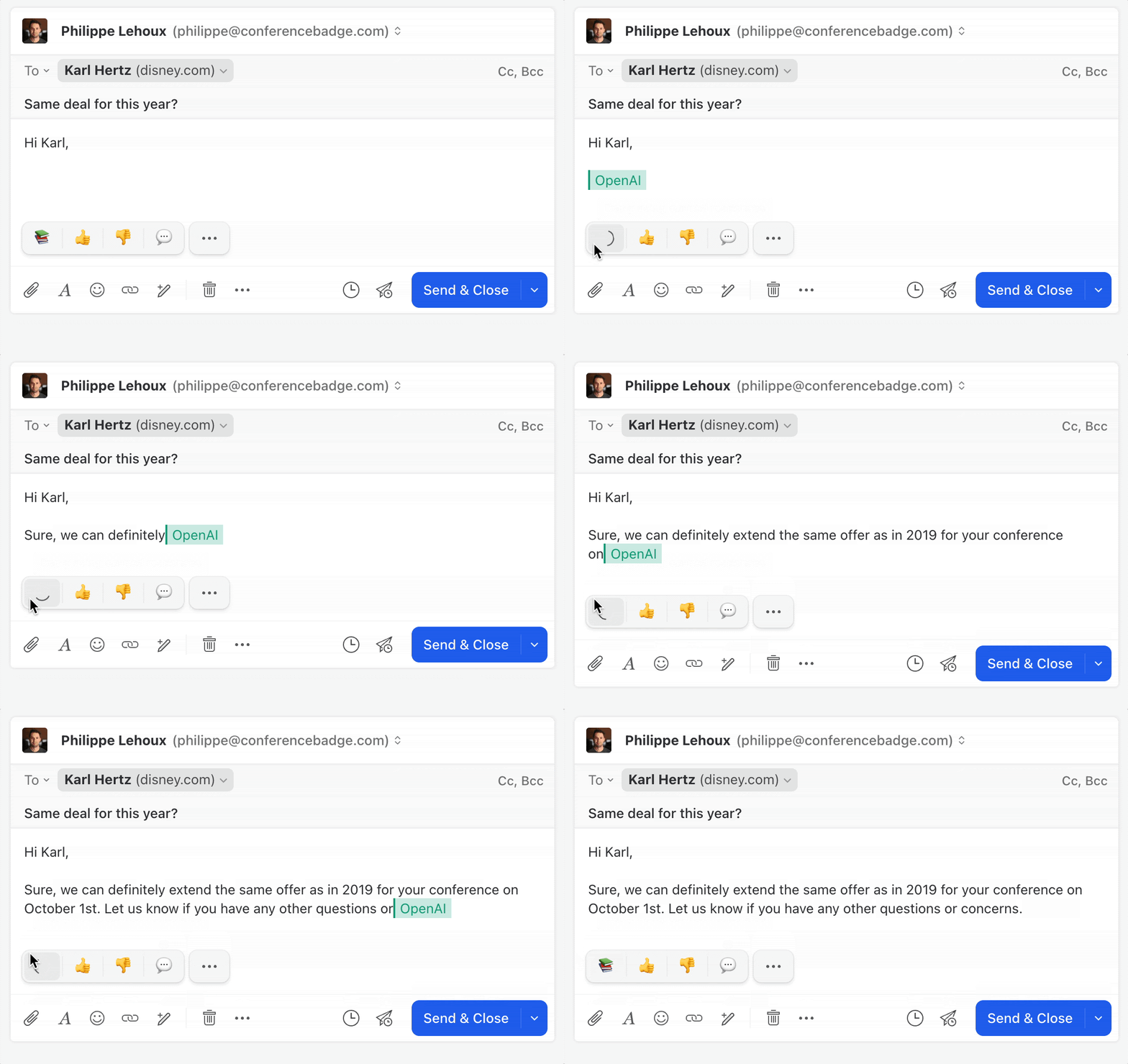
Missive is a team inbox for internal and external communications. It streamlines email, SMS, and social media messages into a unified inbox.
“Missive also provides a platform for real-time interaction with clients and team members. Everyone can stay on the same page: customer support & customer success, PMs, developers, etc.”
— Philippe Lehoux, CEO at Missive
Missive’s AI integration can boost productivity. You get GPT-4o at your fingertips. It lets you:
Summarize and extract key points from customer emails
Missive and Canny have been long-standing partners, and we’re excited to see them doing so well with AI.
Stage 5: Analytics and optimization
Tools that help PMs measure what’s working and act on data.
Amplitude
Amplitude is an AI-powered analytics tool that has been using AI for a while now. Product experts have been relying on Amplitude Recommend since 2021. Amplitude Insight helps PMs monitor product performance, usage, adoption rates, and KPIs.
Since then, Amplitude has expanded its AI toolkit significantly. You can now query your product data in plain language, no SQL required, and get instant visualizations of what’s happening in your product.
Here are some of the AI tools Amplitude has built:
Data Assistant — helps to measure and qualify data
Ask Amplitude — bridges the gap between business questions and insights
Amplitude Experiment — identifies the hypothesis, designs the experiment, builds the variants, deploys the changes, and assesses the results
“All of these AI tools exist primarily to empower product managers. They can ask and answer their own questions about their users. We want PMs to be able to run experiments without needing a data scientist by their side at each step. Our ultimate goal is to bring the best practices of building great products to every PM at every company.”
— Jeffrey Wang, co-founder & chief architect at Amplitude Analytics
Segment (by Twilio)
Good AI runs on clean data. When it comes to customer engagement, the intelligence gets trained on what you feed it. The quality of your data matters.
Twilio’s CustomerAI combines the power of LLMs with rich customer data. This helps product managers engage with their customers more effectively.
Understanding customer needs and pain points better leads to building more tailored products. That’s what Segment can do for product managers.
Kindly.ai
Kindly.ai helps your support and sales teams delight your customers. Based in Oslo, Kindly serves European enterprise clients with an AI chatbot platform. It now includes generative AI capabilities via Kindly GPT.
“To keep up with customers’ ever-changing needs, chatbots need to evolve. At Kindly, we are constantly working on introducing state-of-the-art technologies in our chatbots.”
— Gjermund Norderhaug, Head of Product at Kindly
For product managers, this chatbot can uncover customer feedback and bug reports. Automating the chatbot experience can make idea management a lot easier.
Other tools to consider
Specialized tools worth knowing about, depending on your role.
Recruitee
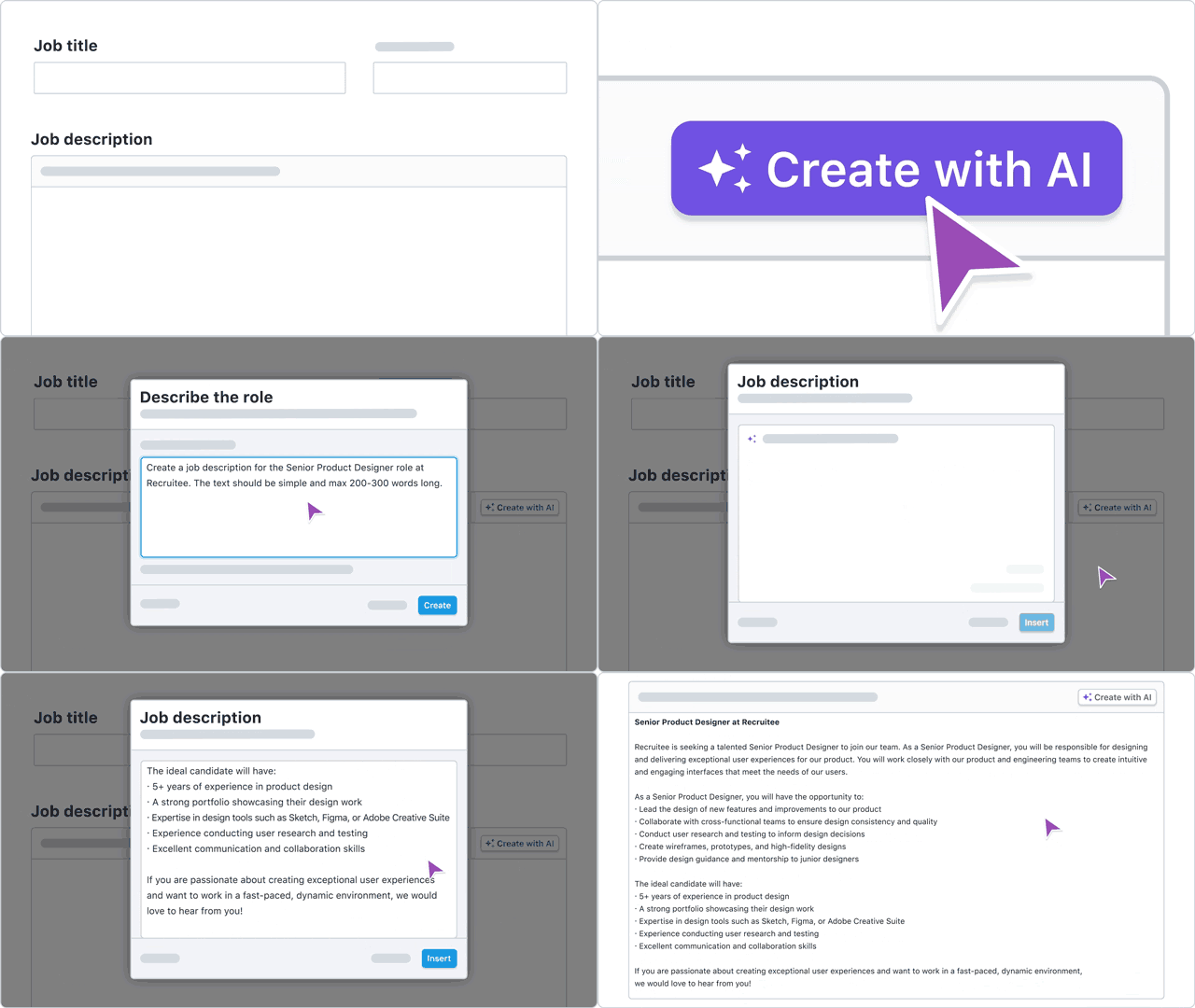
Recruitee helps automate recruitment tasks. It can draft job descriptions, create career site copy, and build email templates for candidates. This helps product managers involved in hiring and growing their teams.
Flux.ai is a niche tool for PCB (printed circuit board) engineers. Its AI addition, Copilot, helps hardware PMs brainstorm solutions, suggest component connections, and answer contextual questions about specific components. If you’re a PM working on hardware products, it’s worth a look.
Kadoa uses AI to extract, transform, and integrate complex data from websites, PDFs, and CSVs. The team has narrowed its focus toward data-heavy industries since we first covered it. The core capability still holds, though. It’s useful for PMs who need to pull unstructured data from external sources at scale. Think competitor pricing pages, market research databases, or partner feeds.
“AI will augment the product managers’ tedious manual work more and more. Cleaning nasty backlogs, writing PRDs, or taking meeting notes will become a thing of the past. This will help them spend more time speaking to customers, deeply understanding their needs, and providing creative solutions to their problems.” — Raphael Allstadt, co-founder and CEO of tl;dv
The next frontier is AI agents. Many AI tools respond to prompts. Agents act autonomously, executing multi-step workflows. They connect to your existing tools and complete tasks without you initiating each step. It’s early, but the direction is clear.
Canny is part of this shift. Our MCP server makes it possible for AI agents to access and act on your feedback data directly. They can merge duplicates, surface trends, and feed insights into your workflow.
Frequently asked questions
What are the best AI tools for product managers?
The best AI tools depend on where in your workflow you need the most help. For research and discovery, Canny Autopilot, Perplexity, and Granola are strong choices. For writing specs and PRDs, ChatGPT, Claude, and ChatPRD are the most widely used. For design and prototyping, Figma AI and v0 by Vercel lead the field. The tools that deliver the most value are ones you use consistently, not ones you collect.
Will AI replace product managers?
Not any time soon. AI handles the repeatable parts of the job well: summarizing research, drafting documentation, analyzing data, and taking meeting notes. The parts that require judgment, customer empathy, and strategic thinking remain distinctly human. The PMs getting the most out of AI use it to spend less time on the former and more time on the latter.
How much time can AI tools save a product manager?
Significant amounts. A large-scale survey of 1,750 product professionals found that 63% of PMs save four or more hours per week using AI tools. A McKinsey study of 40 product managers found a 40% productivity improvement across core PM tasks. The biggest time savings come from meeting notes, writing PRDs, synthesizing research, and competitive analysis.
Can AI help with product roadmapping?
Absolutely. Canny Autopilot automatically organizes and deduplicates customer feedback, which makes prioritization decisions much faster. LLMs like Claude and ChatGPT can help you structure roadmap arguments, write roadmap narratives, and pressure-test prioritization logic. The best outcome is a roadmap grounded in organized feedback, not just gut instinct.
Eric Hoppe
Marketer and aspiring dog-sport competitor 🐕 Eric’s career features stints with innovative companies like Opera Software and Crowd Content.
When he’s not telling the world how great Canny is, Eric's finding ways to get his dogson to be a more competitive frisbee dog.